
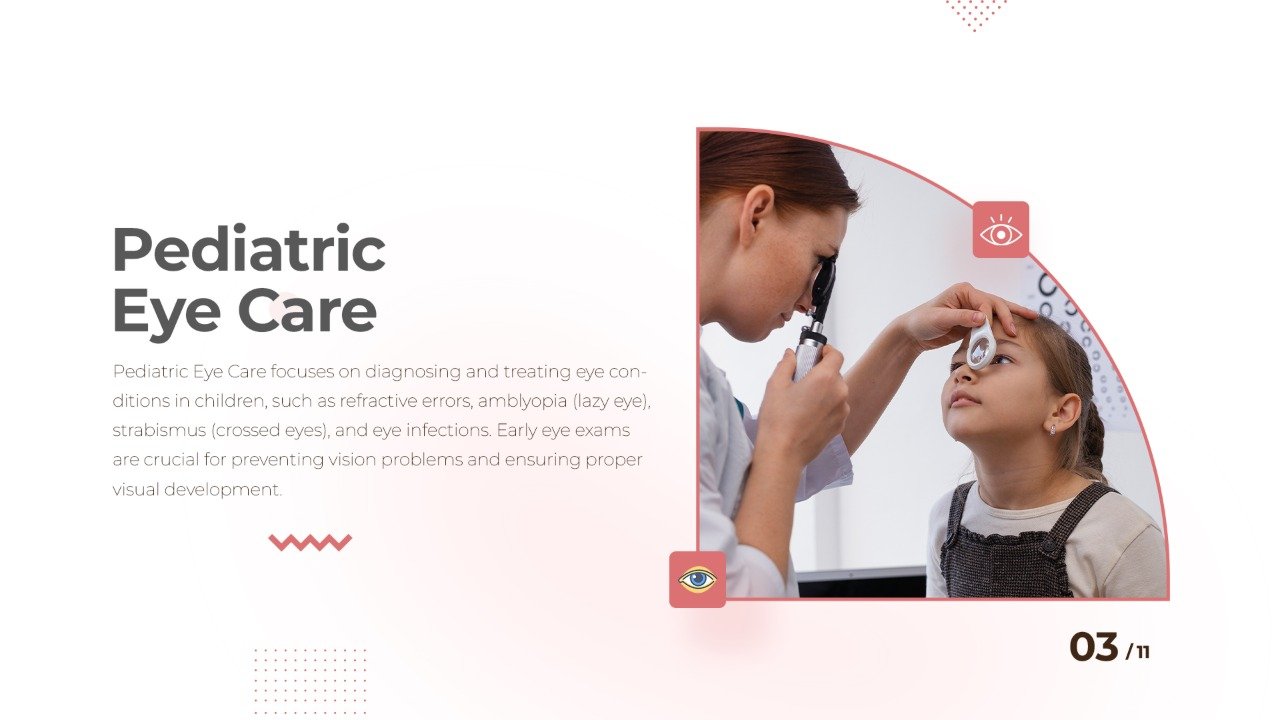

Why Paediatric Eye Care Matters
A child’s visual system develops rapidly in the early years of life. During this sensitive developmental period, untreated eye conditions — such as refractive errors, amblyopia, squint, or lid abnormalities — can interfere with normal visual development and lead to permanent reduction of vision if not identified and managed in time. The earlier a problem is detected, the more effectively it can be treated.
A significant challenge in paediatric eye care is that many children do not report vision difficulties — simply because blurred or abnormal vision has been their normal experience from birth or early childhood, and they have no frame of reference for comparison. This is why regular eye examinations are essential even for children who appear to be seeing and functioning normally.
Conditions Managed in Paediatric Eye Care
- Amblyopia (lazy eye) — reduced vision in one eye caused by abnormal visual experience during development; most treatable when caught early
- Strabismus (squint) — misalignment of the eyes, affecting depth perception and potentially causing amblyopia if untreated
- Refractive errors in children — myopia, hyperopia, and astigmatism, which can affect learning and development
- Congenital conditions — including congenital cataract, congenital glaucoma, and ptosis, which require early specialist management
When Should a Child Have Their First Eye Examination?
It is generally recommended that children undergo a formal eye examination by an ophthalmologist between the ages of three and four years, and again before starting primary school. Infants and newborns should be assessed earlier if there are visible abnormalities, a family history of significant eye conditions, or concerns about visual responsiveness. Children already wearing spectacles or under treatment for an eye condition should attend review appointments as scheduled by their ophthalmologist.
The prevalence of myopia (short-sightedness) is rising significantly among children across urban India, with research pointing to reduced time spent outdoors and increased near-work — including screen use — as contributing factors. In Mumbai’s densely urban environment, many children have limited access to outdoor recreational spaces. Dr. Gotecha provides guidance on myopia management strategies and advises parents on practical protective measures: encouraging outdoor activity, setting limits on recreational screen time, and ensuring adequate indoor lighting during study.
Myopia and Screen Time in Mumbai's Children
A Child-Friendly Consultation
Dr. Archana Sanghvi Gotecha approaches every paediatric consultation with patience, sensitivity, and age-appropriate communication. Children are assessed using techniques that do not require verbal responses — making it possible to evaluate vision accurately even in infants. Parents are actively involved throughout the consultation and provided with clear, actionable guidance on their child’s eye health and any follow-up steps required.
Frequently Asked Questions
A: Signs to watch for include squinting or closing one eye, sitting very close to the television or screen, holding books at an unusually close distance, tilting or turning the head, frequent eye rubbing, complaints of headaches or tired eyes, difficulty at school, or an eye that appears turned in, out, or wandering. However, many children with significant refractive errors show none of these signs — making routine eye examinations essential.
A: Amblyopia treatment is most effective when started early — ideally before the age of seven to eight years, while the visual system is still developing and responsive to change. Treatment becomes progressively less effective with age, though some improvement may still be possible in older children under appropriate supervision. Early examination is always the best approach to maximise the potential for full visual recovery.
